The Loudness War Explained
The loudness war is the decades-long trend of mastering records ever louder — pushing the average level of a track higher and higher until there was no room left to push — in the belief that a louder song grabs listeners and wins on the radio, in a shop, or next to the track before it. It ran from roughly the CD era into the 2010s, it measurably shrank the dynamic range of popular music, and it is essentially over: streaming loudness normalization removed the prize that everyone was fighting for. Understanding why it happened, what it cost, and why it stopped is the fastest way to master your own music sensibly today.
Why "louder" ever seemed to win
The whole war rests on one quirk of hearing: turn any piece of audio up a little and, in a quick side-by-side, it tends to sound better — fuller, punchier, more exciting — regardless of whether it actually is. Louder reads as "better mixed" to an untrained ear for the first few seconds. Producers, labels, and artists all knew this, and each assumed that if their track was the quiet one in a stack — a radio rotation, a compilation CD, a record-shop listening post — it would lose.
So the incentive was never really "make it loud." It was "don't be the quiet one." That's a classic race to the bottom: once one record gets louder, the next has to match it just to not sound weak, and the one after that has to beat both. Nobody could unilaterally stop without appearing to lose, so everyone kept climbing. If you want to hear the effect for yourself before mastering anything, always compare versions at matched loudness — our in-browser audio mastering tool gives you a level-matched A/B for exactly this reason, so "louder" can't quietly fool you into a worse decision.
How we got here: the CD era race
Loudness had a ceiling long before the war, but it was a forgiving ceiling. Vinyl physically resists extreme loudness — cut a record too hot and the stylus literally jumps the groove — and analog tape saturates gently, rounding off peaks rather than destroying them. Both formats pushed back when you pushed too hard.
The compact disc removed that resistance. Digital audio has a hard, absolute ceiling — 0 dBFS, full scale — and below it you can raise the average level as much as your processing allows, right up to the wall, with no groove to skip and no tape to saturate. Once mastering engineers had digital limiters that could clamp the peaks and let them crank everything underneath, the only limit left was 0 dBFS itself. The race had a finish line, and the finish line was a brick wall.
Through the late 1990s and 2000s, mainstream masters crept closer and closer to that wall. The trend became notorious enough to earn a name and a backlash. A frequently cited flashpoint was Metallica's 2008 album Death Magnetic, whose CD master was widely criticized by fans and press for sounding audibly distorted from over-limiting — to the point that the versions of the songs released for the Guitar Hero video game, built from less-squashed mixes, were widely reported as sounding cleaner and more dynamic than the retail CD. Around the same period, audio professionals founded an advocacy campaign — Turn Me Up! — urging artists and engineers to stop over-compressing and release more dynamic records. The war had become a public argument, not just an industry habit.
What "louder" actually costs
Here's the part the loudness itself hides. You cannot make the average level of a finished track higher without doing something to the peaks, because the peaks are what hit the ceiling first. There are only two moves: turn the whole thing down (which defeats the point) or squash the peaks down toward the average so you can raise everything together. The war chose the second move, over and over.
That squashing has a name and a cost: it destroys dynamic range — the distance between the quietest and loudest moments of a track. One way to picture it is crest factor: the gap between a signal's peak level and its average level. A dynamic recording has a large crest factor: sharp transient peaks — a snare hit, a plucked string — sitting well above a lower average. To raise the average toward the ceiling, a limiter has to flatten those peaks, shrinking the crest factor. Do it gently and you get glue and consistency. Do it hard, over and over, and the transients that gave the music its life and impact get planed off. The snare stops punching. The mix stops breathing. Push far enough and the limiter can't keep up and the waveform starts to flatten against the ceiling as literal clipping — audible distortion baked permanently into the file.
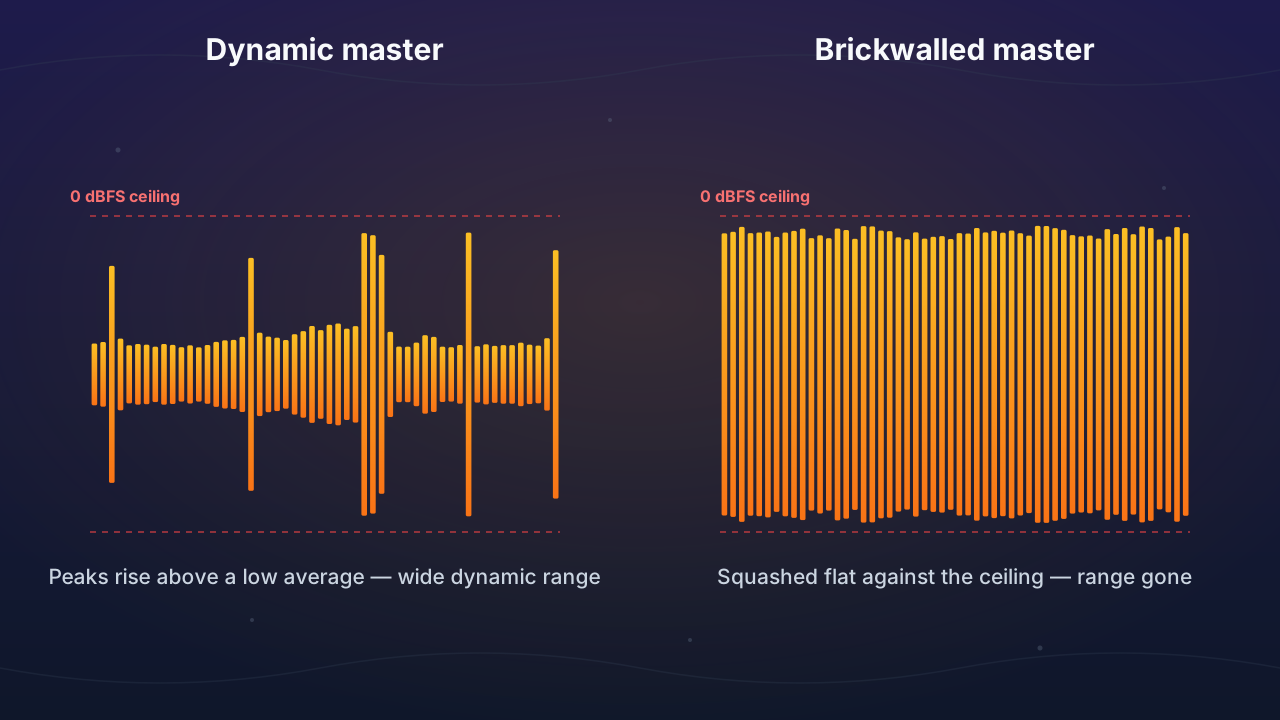
This is the war's real legacy: not that records got loud, but that a generation of masters traded away the dynamic range that makes music feel three-dimensional in exchange for a loudness advantage that — it turned out — was about to evaporate. Purpose-built meters can put a number on it after the fact — the TT Dynamic Range Meter from the Pleasurize Music Foundation scores a track's crest factor as a single "DR" value, and a community-maintained database has used it to catalog how the same album often measures more dynamic on its vinyl or early-CD release than on a later, louder remaster.
Why streaming normalization ended the war
The war ended not because the industry had a change of heart, but because the battlefield disappeared. Streaming platforms introduced loudness normalization: instead of playing every track at whatever level it was mastered to, the platform measures each track's overall loudness and adjusts playback so everything sits at a consistent reference. A track mastered far louder than the target simply gets turned down on playback to match everything else.
That single change removed the entire prize. If the platform is going to level your track against the one before it anyway, being louder at the mastering stage buys you nothing — the listener hears it at the same level as a track mastered with half the loudness and twice the dynamics. Worse than nothing, actually: you kept all the squashing you did to get loud, then handed the platform a track that gets attenuated back down, so your version sounds flatter than the sensible master it's played next to. For the first time, loudness was a losing move.
These platforms measure loudness in LUFS (Loudness Units Full Scale), a hearing-weighted average built on the ITU-R BS.1770 standard, rather than raw peak level — which is the whole point, since peaks were never what "loudness" meant to a listener. Spotify publishes a normalization target of -14 LUFS with true peaks kept below -1 dBTP; broadcast has long worked to the EBU R 128 standard of -23 LUFS. Other music services normalize too, generally landing tracks somewhere in the -14 to -16 LUFS range, though not every platform publishes an exact figure — treat the unpublished ones as convention, not law. If you simply want a finished file moved to a specific loudness without re-mastering it, the volume normalizer measures a track's integrated LUFS and applies the gain to hit your target.
The technology behind normalization isn't new — ReplayGain, first specified back in 2001, was doing loudness matching on people's music libraries years before streaming existed — but streaming is what made it universal and on by default. Once the biggest listening surfaces on earth all normalized playback, mastering to the ceiling stopped making sense for anyone.
How to master today: dynamics over raw level
The modern rule is short: master for the sound you want, not for the loudness meter. Because playback is normalized, your job is no longer to win a level contest. It's to make a track that feels good and holds up when the platform sets its level for you. That flips the old priorities.
A few practical guidelines that follow directly from everything above:
- Protect your dynamics. Use compression and limiting to control and glue the mix, not to crush it flat. If your limiter is pulling down several decibels on every peak, you're fighting the old war for a prize that no longer exists.
- Aim near the streaming target and stop. Mastering to roughly -14 LUFS integrated with true peaks at or below -1 dBTP puts you in the right zone for most streaming without over-squashing. Going much louder just gets turned back down.
- Leave true-peak headroom. Keeping peaks at -1 dBTP guards against the inter-sample overshoots that lossy encoding can introduce — a real clipping risk a normal peak meter won't warn you about. See what audio headroom is for why that margin matters.
- Trust a level-matched A/B, not your gut. The "louder sounds better" bias is the reason the war happened at all. Compare your master to a reference at equal loudness so you're judging tone and dynamics, not volume.
You don't need a studio or a paid plugin chain to do this. Our free audio mastering tool runs a real Web Audio DSP chain — EQ, multiband compression, stereo width, and a brickwall limiter — with live BS.1770 LUFS metering and a level-matched A/B, entirely in your browser. It's free, unlimited, needs no account, and your audio never leaves your device — the processing engines download to you, not the other way around. For a full walkthrough of the process, see how to master a song online for free; to move an already-finished file to a target level, how to normalize audio volume; and to see where mastering fits in the bigger picture, the beginner's workflow from raw recording to finished edit. If the master is finished and the next step is getting it onto the platforms, how to prepare a song for streaming release covers the loudness check, the delivery file, and the metadata.
Frequently asked questions
Is the loudness war over? For the most part, yes. Streaming loudness normalization plays every track at a consistent reference level, so mastering louder than the target no longer makes a song sound louder to listeners — it just gets turned back down on playback. The commercial incentive that drove the war is gone, and most modern mastering has shifted back toward preserving dynamics rather than maximizing raw level.
Does making my master louder still help on Spotify? No. Spotify normalizes playback toward a loudness target, so a master pushed well above it is simply attenuated back down to match everything else. You gain no loudness advantage, and you keep all the squashed dynamics you created chasing it — meaning your track can end up sounding flatter than a quieter, more dynamic master played right beside it at the same level.
What is dynamic range, and why does loudness reduce it? Dynamic range is the distance between the quietest and loudest moments in a track. To raise a track's average level toward the digital ceiling, a limiter has to flatten the peaks down toward the average, which shrinks that distance. Push hard enough and transients like snare hits lose their punch and the music stops breathing — that lost range is the direct cost of chasing loudness.
What LUFS should I master to now? Around -14 LUFS integrated with true peaks at or below -1 dBTP suits most streaming, and roughly -16 LUFS works for spoken-word or podcast material. These are targets to land near, not to exceed — because playback is normalized, mastering much louder gains nothing and costs you dynamics. Aim for the sound you want first, then check you're in that loudness zone.
Why does louder audio sound better at first? A quick increase in level reads to the ear as fuller and more exciting for the first few seconds, independent of whether the audio is actually better. That short-lived bias is exactly what fueled the loudness war — every version sounded like the winner in an unmatched comparison. Judging masters at equal loudness removes the illusion and lets you hear tone and dynamics honestly.