What Is a Transient?

A transient is the short, high-energy burst of sound at the very start of a note — the sharp attack before the tone settles down. It's the thwack of a drum stick hitting a skin, the pluck of a guitar string, the hard t or k at the front of a spoken word. It lasts only a few milliseconds, but it carries most of a sound's punch, clarity, and sense of timing.
Here's the whole idea in one line: a transient is the attack — the brief spike of energy that opens a sound, before it decays into its sustained body. Everything below is why that spike matters and what happens when you process it.
What a transient actually is
Almost every sound has a shape over time, and a useful way to describe it is the attack, sustain, and decay. The attack is the very beginning — how quickly the sound jumps from silence to full volume. The sustain is the steady body that follows. The decay is the tail as it fades away.
The transient is that attack phase: the fast, loud opening moment. It's called "transient" because it's transitory — over almost as soon as it begins, usually within 5 to 50 milliseconds. A snare's crack, a piano key's initial thunk, the click of a hi-hat, the scrape at the start of a bowed cello note — all transients.
What makes them special is energy density. A transient packs a lot of level into a very short time. That sudden jump is exactly what your ear is tuned to notice, because in nature a sharp onset usually means something just happened — a footstep, a snapping twig. We're wired to lock onto attacks.
Two things follow from that, and they're the reason transients matter so much in audio:
- Transients carry punch and clarity. The attack is what makes a drum feel like it hits rather than just hums, and what makes a consonant crisp enough to understand. Soften the transients and a mix goes dull and mushy; sharpen them and it snaps into focus.
- Transients carry timing. Your ear locates a sound in time by its onset, not its tail. The instant a beat "lands" is the instant its transient arrives. That's why rhythm lives in the attacks.
How a transient looks on a waveform
Transients are easy to spot once you know the shape. On a waveform — the plot of amplitude over time you see in every editor — a transient shows up as a sharp, near-vertical spike: the line shoots from the quiet baseline up to a tall peak almost instantly, then falls away into the lower, rounder shape of the sustain and decay.
A dance track is the clearest example. Look at one zoomed out and you'll see an evenly spaced row of tall, narrow spikes standing above everything else — that's the kick drum, one transient per beat, like a picket fence. Speech looks different: clusters of medium texture (the vowels and body of words) punctuated by quick spikes where the hard consonants hit.
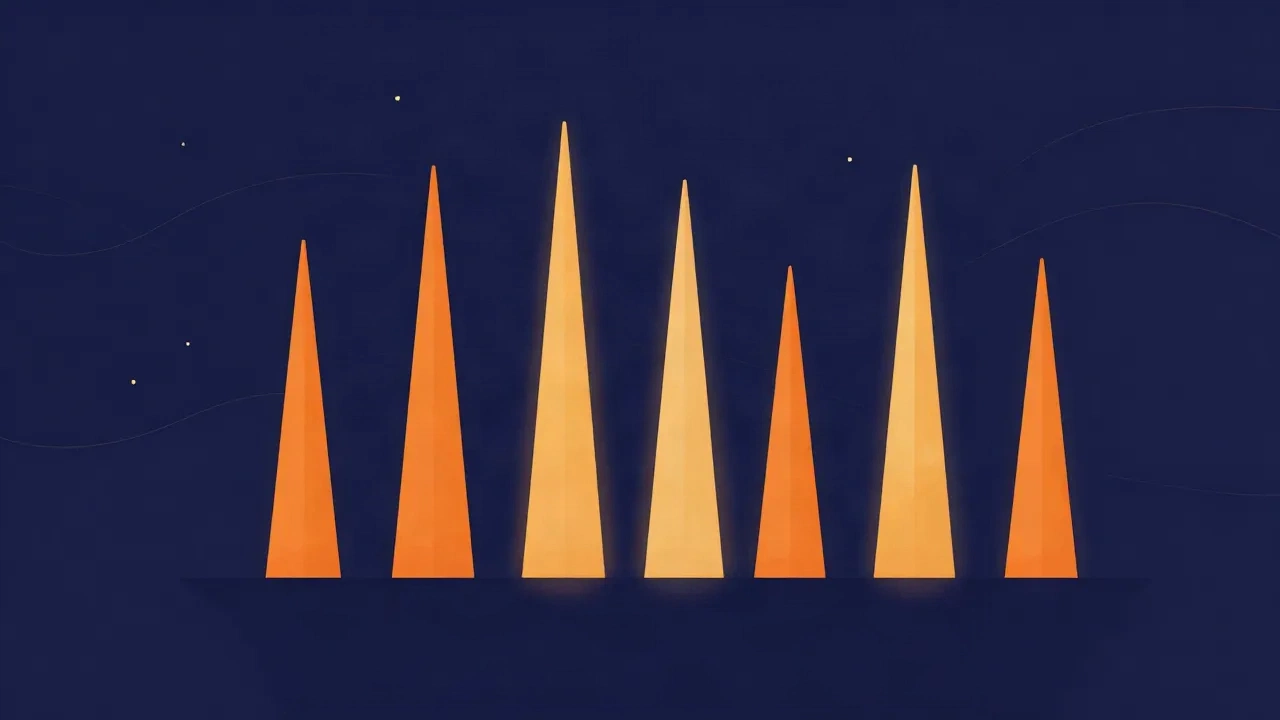
Because the attack is so much taller than the rest of the sound, transients are usually the tallest peaks in a clip. That has a practical consequence: they're the first thing to run out of headroom and clip when a signal gets too loud. A track can measure comfortably quiet on average while its transient peaks are slamming into the ceiling — which is one reason peak level and perceived loudness are different measurements. If you want the units behind those levels, what a decibel is covers the scale transients are measured on.
How processing changes transients
Most of what mixing engineers do to "shape" a sound is really shaping its transients. A few of the common tools:
Compressor attack and release. A compressor turns down loud parts of a signal, and its attack setting controls how fast it reacts. This matters enormously for transients. A slow attack lets the transient through before the compressor clamps down — so the attack stays sharp and punchy, and only the body gets squashed. A fast attack catches the transient itself and flattens it — which tames the peak but can make a drum sound softer and duller. The release setting then controls how quickly the compressor lets go afterward. Learning to hear that trade-off is most of what dialing in a compressor comes down to.
Transient shapers. These are tools built for one job: making attacks stronger or weaker directly, independent of overall level. Turn the attack up and a flabby drum becomes punchy; turn it down and a clicky, aggressive sound gets rounder and softer. A transient shaper is the most direct control you have over the very thing this article is about.
Limiters and loudness. When a track is pushed loud for streaming, the loudest transients are the first to get limited and squashed. Push too hard and the punch disappears — the mix gets louder but flatter. Managing that balance is a core part of mastering, where the goal is loudness without crushing the life out of the attacks.
Why cutting on a transient causes clicks
Here's a practical trap that trips up almost everyone at some point. If you cut, trim, or splice audio right on a transient — or anywhere the waveform is mid-swing — you often get an audible click or pop at the edit point.
The reason is that a cut forces the signal to jump instantly to (or from) silence. If the waveform happened to be at a high value the moment you cut, that instantaneous jump is a tiny transient — a step change the speaker reproduces as a click. And a transient, being a tall sharp spike, is the worst possible place to cut, because that's where the signal is furthest from silence.
The fix is to cut at a zero crossing — a point where the waveform passes through the centre line, meaning the signal is momentarily at zero. Cutting there means no sudden jump, so no click. Most editors either snap edits to zero crossings automatically or apply a tiny fade at the cut to smooth the join. The full explanation, including why lossless formats matter here, is in how to cut audio without losing quality — and you can try clean cutting in the browser with the audio cutter, which handles the edit boundary for you.
Transients in editing and mixing
Beyond avoiding clicks, transients quietly drive a lot of everyday audio work:
- Beat detection keys off transients. When a tool finds the tempo of a song, it's really detecting the regular spikes of the kick and snare and measuring the spacing between them. That's why a track with soft, smeared attacks — an ambient pad, a legato string piece — is genuinely hard to analyze: there are no crisp onsets to lock onto. If you've ever seen a BPM detector give weird results, fuzzy transients are often the culprit, and the BPM finder leans on those attacks to count the beat.
- Lining up and syncing. Because the attack marks the exact instant a sound lands, transients are visual metronome marks. Matching the spikes of two clips is how you align them, tighten timing, or snap a part to a grid.
- Editing dialogue and vocals. In speech, the consonants are the transients. Cutting between words means finding the quiet gap before the next hard consonant, not slicing through the middle of one — do that and you clip the attack, and the word sounds soft or mumbled.
- De-essing and taming harshness. Some transients are too strong — a spiky "s", a clicky pick attack, a snare that's all crack and no body. Softening specific transients smooths those over without dulling everything else.
In every case the transient is the thing your ear latches onto first, so it repays the most careful handling.
The takeaway
A transient is the short, high-energy attack at the start of a sound — the drum hit, the plucked string, the hard consonant. It lasts only milliseconds, but it carries the punch that makes audio feel alive and the timing your ear uses to place a beat. On a waveform it's the sharp spike; in processing it's what a compressor's attack setting and a transient shaper are built to control; and in editing it's why you cut at a zero crossing rather than on the peak. Get comfortable reading and handling transients and a surprising amount of audio work — punch, clarity, rhythm, clean edits — starts to make sense.
Every tool mentioned here runs on vocalcut.com free and entirely in your browser, with no upload and no account — your audio never leaves your device.
Frequently asked questions
What is a transient in audio? A transient is the brief, high-energy burst of sound at the very start of a note — the attack, before the tone settles into its sustained body. It typically lasts only a few milliseconds. Examples include a drum hit, a plucked guitar string, or the hard consonant at the front of a spoken word. Transients carry most of a sound's punch and its sense of timing.
Why do transients matter? They do two important jobs. First, they carry punch and clarity — the sharp attack is what makes a drum feel like it hits and a consonant sound crisp. Second, they carry timing: your ear locates a sound in time by its onset, so rhythm lives in the attacks. Softening transients makes audio dull and mushy; sharpening them makes it snap into focus.
Why does cutting audio on a transient cause a click? A cut forces the signal to jump instantly to or from silence. If the waveform is at a high value at that moment — which it is on a transient — that sudden jump is itself a tiny click that the speaker reproduces. The fix is to cut at a zero crossing, a point where the waveform passes through the centre line and the signal is momentarily at zero, so there's no sudden jump.
How does a compressor's attack setting affect transients? The attack setting controls how fast the compressor reacts. A slow attack lets the transient pass through before the compressor clamps down, keeping the attack sharp and punchy. A fast attack catches the transient itself and flattens it, which tames the peak but can make the sound softer and duller. Choosing between them is how you decide whether to preserve or control a sound's punch.